
Key facts: Structural Drying
- Structural drying uses dehumidification, airflow and sometimes heat to remove moisture from building materials, guided by moisture measurements [1].
- EPA advises drying water-damaged materials within 24 to 48 hours to reduce the chance of mold [2].
- Drying is complete when materials reach the normal moisture level of similar dry materials in the same building, not when they feel dry to the touch [1].
- Oklahoma's weather swings from dry, windy days to very humid ones, which changes how fast a house dries [3].
What it is
What structural drying actually does
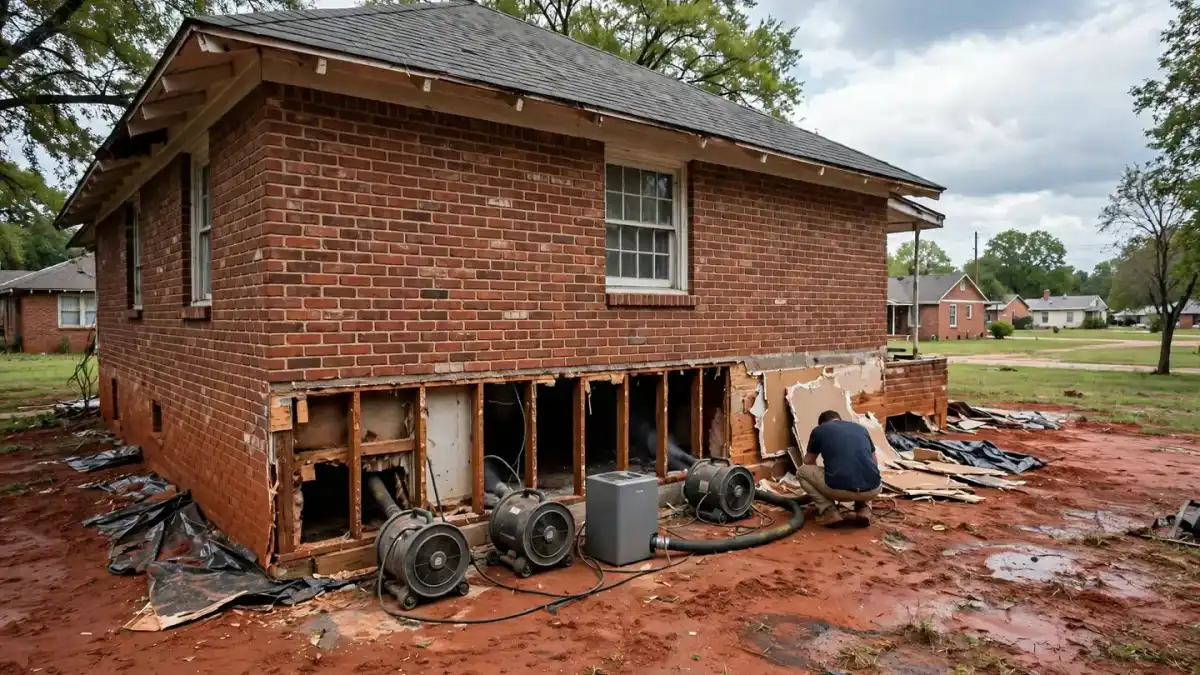
Structural drying is the part of water damage restoration that removes moisture from the building itself: the drywall, studs, plates, subfloor, joists, concrete slab, cabinets and trim. It works by controlling three things at once. Dehumidifiers pull water vapor out of the air. Air movers push that drier air across wet surfaces so moisture evaporates faster. Temperature is managed so evaporation stays efficient. Together they create conditions where water leaves the materials and is captured and pumped away [1].
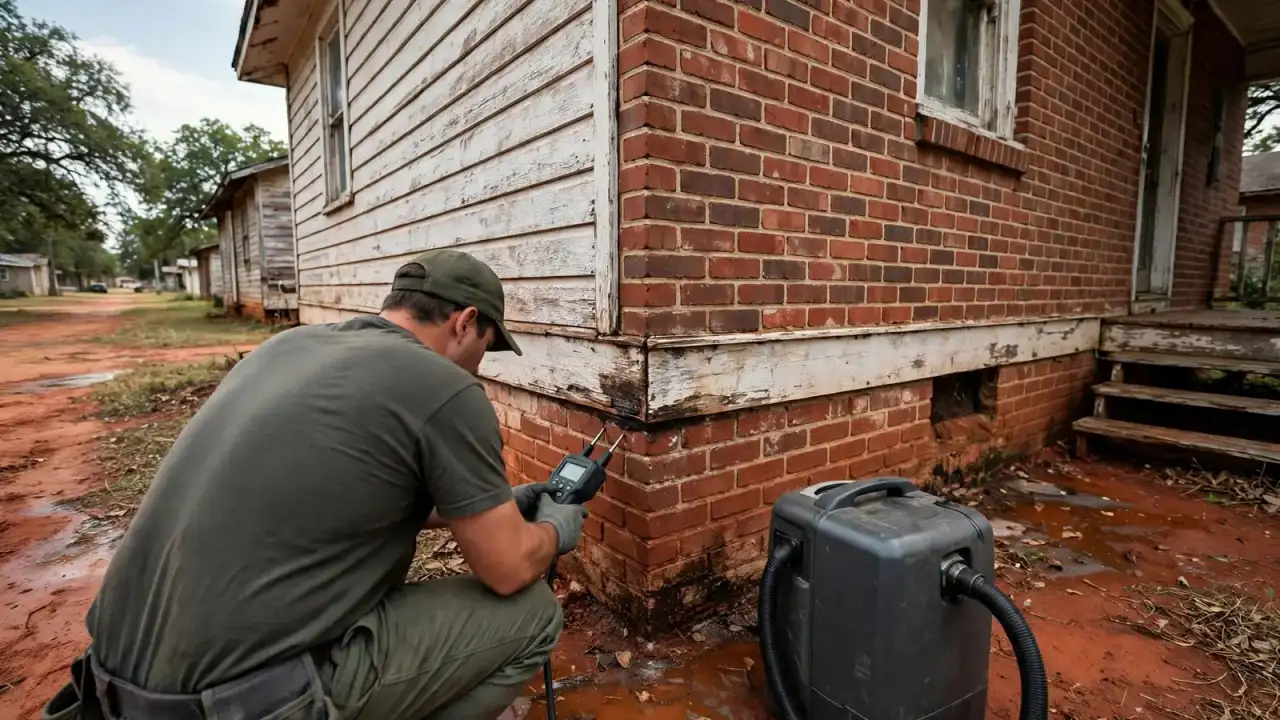
The process is guided by measurement rather than appearance. A wall can look and feel dry while the bottom plate behind it is still saturated. Restoration technicians use pin and pinless moisture meters, thermal cameras and thermo-hygrometers to see where water is, how much is there and whether it is leaving. They compare readings with dry areas of the same house to set a drying goal.
The aim is to get materials back to normal moisture levels quickly enough to prevent mold, warping, odor and decay. EPA's guidance is to dry water-damaged materials within 24 to 48 hours where possible [2]. Not every material can be fully dry in that time, but starting drying promptly keeps conditions from favoring mold growth.
Signs
Signs a house is not drying on its own
Baseboards stay dark
A damp line along the bottom of walls that does not fade means water is trapped in the drywall and plate.
Musty smell that grows
Odor that gets stronger after the first day suggests materials are holding enough moisture to support microbial growth.
Read morePaint bubbling or peeling
Water behind the paint lifts it in blisters, often days after the leak.
Floors cupping
Hardwood boards with raised edges are absorbing moisture from below.
Cabinet bases swelling
Particleboard toe kicks and cabinet floors swell and crumble when wet.
Condensation on windows
Heavy condensation on cool days shows very high indoor humidity.
Daily readings show whether materials are drying
How drying works
Evaporation, dehumidification and airflow explained
Water leaves a material when the air around it is drier than the material. In a closed, wet room, the air quickly becomes saturated and evaporation slows to a crawl. A dehumidifier keeps the air dry by condensing or absorbing water vapor and sending it to a drain or pump. Air movers then sweep that dry air across wet surfaces at high speed, replacing the thin layer of moist air that clings to them. The faster that boundary layer is replaced, the faster water evaporates.
Temperature matters because warm air holds more moisture and speeds evaporation. In winter, crews may keep the heat on or add heaters; in summer, they may rely on the air conditioning and dehumidifiers to keep conditions stable. Too much heat without enough dehumidification simply moves moisture to cooler parts of the house, where it can condense.
Some materials dry from the surface easily. Others, such as hardwood, concrete and plaster, release water slowly from deep inside. Drying those takes longer and sometimes needs specialized equipment such as floor drying mats or wall cavity injection systems that push dry air into the space behind drywall.
Equipment
Drying equipment and its job
| Equipment | Job | Notes |
|---|---|---|
| Low-grain refrigerant dehumidifier | Removes water vapor from the air | Works well in typical indoor temperatures |
| Desiccant dehumidifier | Absorbs moisture with a drying wheel | Useful in cool conditions and for dense materials |
| Air mover | Blows air across wet surfaces | Placed in patterns around the room |
| Wall cavity drying system | Pushes dry air into wall cavities through small holes | Can avoid removing some drywall |
| Floor drying mats | Draw moisture out of hardwood floors | Used with suction from a vacuum unit |
| HEPA air scrubber | Filters particles from the air | Used when contamination or mold is present |
The process
How a structural drying job runs
- 1
Inspect and map
The crew finds every wet area with meters and thermal imaging and draws a moisture map of the affected rooms.
- 2
Set a drying goal
Readings from unaffected areas set the target for each material.
- 3
Remove what will not dry
Wet carpet pad, saturated insulation and badly swollen materials are removed. Drywall may be cut above the wet line.
- 4
Open cavities
Baseboards are pulled, small holes drilled or toe kicks removed so air can reach hidden water.
- 5
Place equipment
Dehumidifiers and air movers are positioned based on the room size and how much water is present.
- 6
Monitor daily
Readings are taken every day, equipment moved and the plan adjusted.
- 7
Confirm dry
When materials reach the goal, the equipment is removed and the readings are documented.
Homeowner tips
How you can help a drying job succeed
- Keep doors and windows closed unless the technician says otherwise; outside air can work against the dehumidifiers.
- Leave the equipment running and plugged in, even at night. Turning it off resets progress.
- Keep the thermostat where the crew asks, usually a normal comfortable setting.
- Do not move air movers or dehumidifiers; they are placed for a reason.
- Empty the dehumidifier reservoir only if it does not have a drain hose or pump, and only if the crew asks you to.
- Let the crew in each day for readings, or arrange access.
- Watch for new stains, odors or warping and report them.
Oklahoma City climate
Drying in Oklahoma City's changeable weather
Oklahoma City's weather can swing widely in a single week. Dry, windy days with low humidity alternate with muggy stretches when Gulf moisture streams north, especially in late spring and summer. The Oklahoma Mesonet records these swings across the state [3]. For a drying job, that means outside air can either help or hurt, and the right choice changes from day to day.
On a dry, breezy day, opening the house can help. On a humid day, it does the opposite. Professional drying usually keeps the house closed and controls conditions inside with dehumidifiers, so progress does not depend on the weather. In winter, hard freezes mean heat must be maintained, both for drying and to prevent more frozen pipes.
Summer heat adds a twist. Attics in Oklahoma City can get extremely hot, and wet insulation or framing in the attic may dry quickly on its own while also pushing moisture down into ceilings. Monitoring the ceiling below an attic leak matters even when the attic seems to be drying.
Foundations
Drying slab homes versus pier-and-beam homes
Most Oklahoma City homes built since the 1960s are on concrete slabs. When water spreads across a slab, it soaks the carpet and pad, gets under hard flooring, and wicks into the bottom of drywall and the wood bottom plates. The concrete itself absorbs some water and releases it slowly. Drying focuses on the lower walls and the floor surface, and new flooring should not go down until the slab reads dry.
Older homes in central neighborhoods often sit on pier-and-beam foundations with a crawlspace. Water drains through the floor into the crawlspace, wetting the subfloor and joists from below. The red clay soil typical of the area holds water and can stay muddy for a long time [6]. Drying a pier-and-beam house usually means drying the crawlspace too, with water pumped out, wet debris and insulation removed and dehumidifiers placed under the house.
Both foundation types benefit from attention to grading and gutters afterward. Water that pools against the foundation can find its way back in, and repeated wetting and drying of clay soil can contribute to foundation movement.
Mold
Drying and mold prevention
Mold needs moisture, food and time. Building materials such as drywall paper, wood and carpet backing provide the food, and a water loss provides the moisture. Fast, thorough drying removes the moisture before mold can establish itself, which is why drying is the best mold prevention there is. CDC notes that mold can grow on many surfaces when moisture is present and recommends fixing the water problem and cleaning up mold promptly [5].
If mold is already visible or the water sat for several days, drying is combined with containment, removal of affected materials and cleaning. In those cases the crew may set up plastic barriers and HEPA air scrubbers to keep spores from spreading during the work. See mold risk after water damage for what to watch for.
Drying times
How long different materials usually take to dry
| Material | Typical drying time | What slows it |
|---|---|---|
| Drywall, lightly wet | 1 to 3 days | Vinyl wallpaper or oil paint on the surface |
| Wood studs and plates | 2 to 5 days | Dense lumber, trapped behind cabinets |
| Carpet dried in place | 1 to 3 days | Saturated pad, cool temperatures |
| Hardwood floors | 3 to 10 days or more | Thick boards, water below the subfloor |
| Concrete slab | Several days to weeks | Thickness, coverings, humid weather |
| Crawlspace framing | 3 to 7 days or more | Wet clay soil, limited airflow |
Permits
Repairs after drying and the permit office
Drying itself does not need a permit. Repairs that follow sometimes do. In Oklahoma City, building, electrical, plumbing and mechanical permits are handled by the city's Development Services Department [4]. Replacing drywall and flooring is usually not permitted work, but replacing framing, rewiring circuits that were underwater, or replacing a furnace or water heater typically is. Homes in historic preservation districts may also need approval for exterior changes.
Ask the contractor which repairs on your job will need permits and who will pull them. Keeping the drying records with your permit paperwork shows inspectors and future buyers that the structure was properly dried before it was closed up.
Questions to ask
Questions to ask about structural drying
- What drying goal are you using for each material, and how did you set it?
- How many dehumidifiers and air movers will you use, and why?
- Will you need to remove drywall, or can you dry the cavities in place?
- How will you dry under cabinets and behind built-ins?
- Will you dry the crawlspace or slab as well as the rooms?
- Can I see the daily moisture readings?
Related
Drying and the rest of the water damage job
Drying follows water extraction, which removes the bulk water. If the loss came from a frozen or broken pipe, see burst pipe water damage. For contaminated water, sewage backup cleanup adds cleaning and disinfection to the drying process. Our guide on how long drywall takes to dry goes into more detail on walls.
Plaster and older homes
Drying plaster walls in older Oklahoma City houses
Homes built before the 1950s in neighborhoods such as Heritage Hills, Mesta Park and Crown Heights often have plaster walls on wood or metal lath. Plaster holds a lot of water and releases it slowly, but it is also tough and usually survives a water loss well if it is dried properly. It does not need to be torn out as readily as drywall.
Drying plaster takes patience. Wall cavity drying systems, steady dehumidification and moderate heat are common approaches. Plaster that has lost its grip on the lath, sags or crumbles needs repair. Older homes may also have lead paint on trim and walls and asbestos in some materials, so any demolition should follow testing and the right precautions.
Cabinets
Kitchen and bathroom cabinets during drying
Cabinets are one of the hardest parts of a house to dry. Water runs under the toe kick and spreads beneath the cabinet floor, where it soaks particleboard and the drywall behind. From the front, everything looks fine. Left alone, that hidden space stays wet for weeks and develops a musty smell.
Common approaches include removing the toe kick panel, drilling holes in the cabinet floor or back, and directing air or a cavity drying system into the space. Particleboard that has swollen will not return to shape and is usually replaced. Solid wood and plywood cabinets often dry successfully. Countertops can often be saved even when cabinet boxes need replacing.
Power and noise
Living with drying equipment
A typical drying setup in a few rooms includes several air movers and one or more dehumidifiers running around the clock. The noise is steady and loud, rooms get warm, and the equipment draws a lot of electricity. Some families stay elsewhere for a few days; others close off the drying rooms and live around them.
Keep cords out of walkways, keep pets away from the equipment, and do not cover air movers or dehumidifiers. If a breaker trips, tell the crew rather than unplugging units at random. Keep your utility bills for the drying period; extra electricity used by the equipment is sometimes reimbursed as part of the claim.
Attics
Drying attics and ceilings after roof leaks
Hail and wind storms are a fact of life in central Oklahoma, and damaged roofs let rain into attics. Water soaks blown-in insulation, which then sits on the ceiling drywall like a wet blanket, adding weight and keeping the drywall damp. Ceilings can sag and stain, and in bad cases collapse.
Drying usually starts with removing the wet insulation, because it holds water against the ceiling and dries very slowly. The ceiling drywall is then evaluated: if it is sound, it can often be dried from below with air movers and dehumidifiers; if it sagged, it is replaced. The roof must be tarped or repaired first, or the next storm will undo the drying. New insulation goes in only after the ceiling and framing read dry.
Records
Why drying records matter later
A drying job produces a record: the moisture map, daily readings, equipment placed and removed, and photos of what was taken out. That record is useful to your insurer, who wants to see that drying was necessary and complete. It is also useful later, when you sell the home or if a musty smell ever returns, because it shows the structure was dried to normal levels before it was closed up.
Ask the contractor for a copy of the drying log at the end of the job and keep it with your homeowner records. If any part of the house did not reach its goal, ask why and what was done about it.
Hardwood
Drying hardwood floors without ruining them
Solid hardwood floors absorb water through their edges and from the subfloor beneath. As boards swell, they cup, with edges higher than centers. Drying them evenly from both sides gives the best chance of the boards relaxing back toward flat. Floor drying mats or panels placed over the boards draw moisture up and out, while dehumidifiers keep the room air dry.
Patience matters. Sanding cupped floors before they are fully dry can leave them crowned once the last moisture leaves, with centers higher than edges. Engineered wood floors, with a thin veneer over a core, are less forgiving and may delaminate. A floor that stays cupped after drying may need refinishing or partial replacement.
FAQ
Structural drying questions
How long does structural drying take?
Many homes reach their drying goals in three to five days. Hardwood, concrete, plaster and crawlspaces can take longer. Daily readings show when drying is finished.
Why is the equipment so loud?
Air movers push large volumes of air at high speed, and dehumidifiers run compressors and fans. The noise is temporary and part of drying efficiently.
Can I turn the equipment off at night?
It is best not to. Drying depends on continuous operation; turning equipment off lets humidity rise again and slows progress.
How do you know when the house is dry?
Readings in wet materials are compared with readings in the same materials in dry parts of the house. When they match the goal, drying is complete.
Do you have to tear out my drywall?
Not always. Lightly wet drywall can often be dried in place, sometimes with small holes for airflow. Drywall soaked by contaminated water or wet for too long is usually cut out.
Will drying prevent mold?
Prompt, thorough drying is the best prevention. If mold has already started, drying is combined with containment and removal.
Does the electricity used by drying equipment matter?
Drying equipment draws a lot of power. Your insurer may cover the extra electricity used; keep your utility bills and ask your adjuster.
Why are there holes drilled at the bottom of my walls?
Small holes let dry air into wall cavities so trapped moisture can escape without removing the drywall. They are patched once the wall is dry.
Can I open the windows to help the house dry?
Only on dry, breezy days and only if the technician agrees. On humid days, outside air adds moisture and works against the dehumidifiers.
What if the readings stop improving?
That usually means water is trapped somewhere the air cannot reach, such as under a cabinet, behind a tub or beneath flooring. The crew may need to open that area or change the equipment setup.
Will my insulation be replaced?
Wet insulation is usually removed because it holds water and dries poorly. It is replaced once the framing and drywall around it have dried.
Should I run my own air conditioner during drying?
Usually yes, at a normal setting, unless the technician says otherwise. The air conditioner removes some moisture and keeps temperatures steady. If the HVAC system itself got wet, have it checked first.