
Key facts: Burst Pipes in Capitol Hill
- Lines running through crawlspaces, garages and outside walls are the ones most likely to freeze and split [1].
- Many Capitol Hill homes are wood-frame houses on piers, so leaking water often drops into the crawlspace instead of pooling on the floor [7].
- The Norman office of the National Weather Service posts hard freeze and winter storm alerts for south Oklahoma City [4].
Why Capitol Hill pipes freeze under the floor
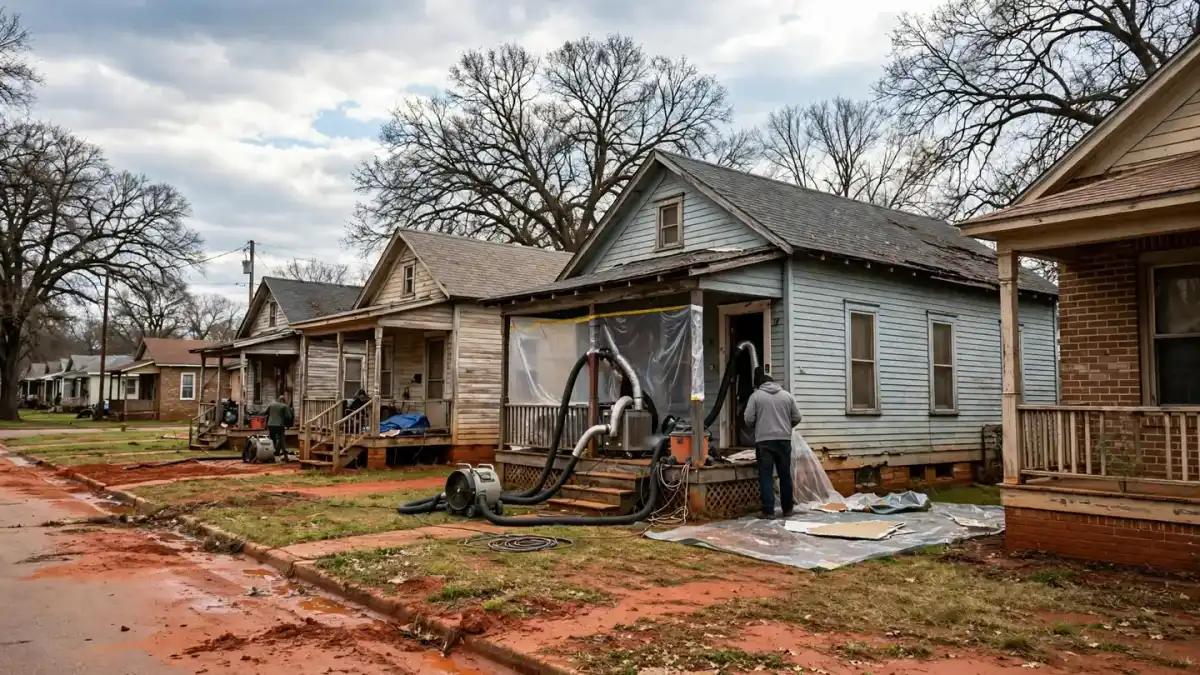
A large share of the houses near SW 25th Street and Commerce Street were built before 1950 and sit on piers a short distance above the ground. The space beneath them is open to winter air through vents, gaps in skirting and old access doors. Supply lines that run along the joists in that space have little protection when the temperature drops well below freezing for a night or two.
Lines also freeze in rooms that were added later. A back porch enclosed as a laundry room, or a carport closed in as a bedroom, may have thin walls and little insulation. Pipes run to a washer or a sink in those rooms are often the first to burst after a cold snap.
How a split line shows itself in a pier-built house
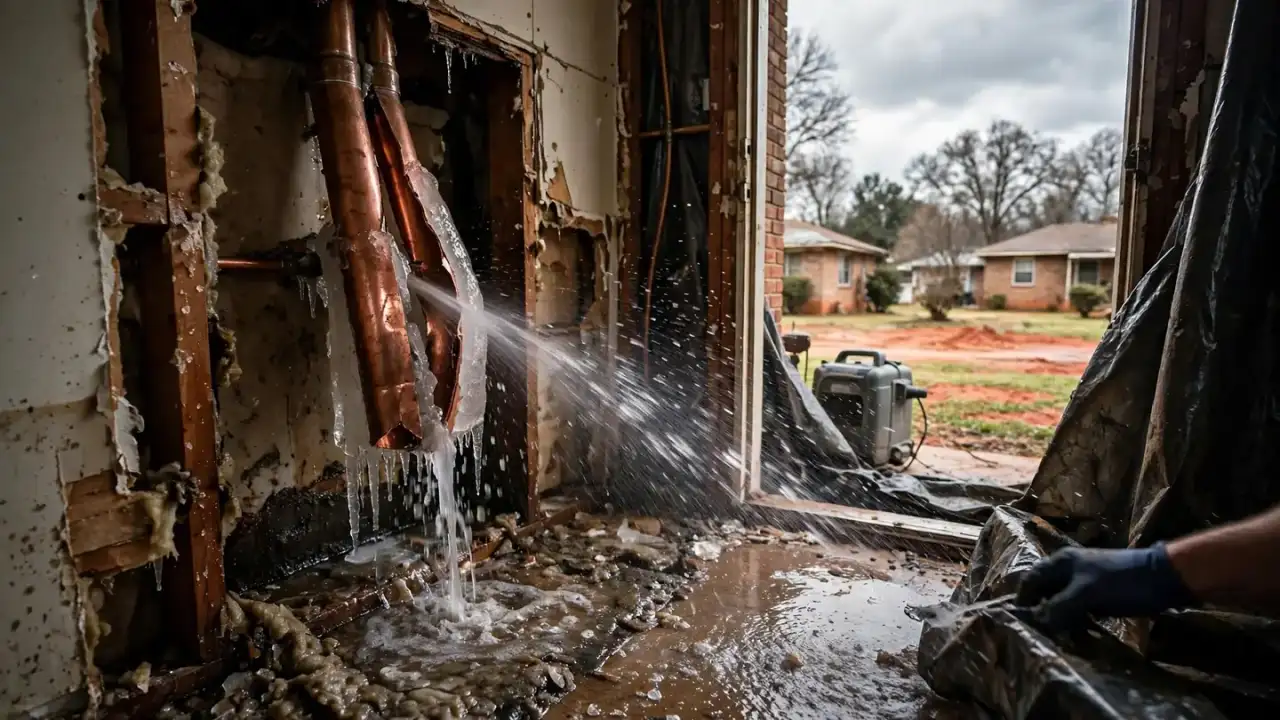
In a slab house, a burst pipe usually floods the floor where everyone can see it. In a Capitol Hill house on piers, much of the water runs through gaps in the planks and drops into the crawlspace. You may only notice a hissing sound, a drop in water pressure, a damp patch in the flooring or a meter that keeps spinning.
Hidden water is still water damage. Joists, sill plates and the underside of the subfloor soak it up. If the leak runs for hours before anyone looks underneath, the crawlspace soil can turn to mud and the wood stays wet long after the pipe is fixed.
First moves after a Capitol Hill pipe bursts
A simple order that suits older frame homes.
- 1
Close the main or the meter valve
Shut the house valve if you can find it; otherwise the curb valve at the meter stops the flow.
- 2
Turn off power to wet rooms
Switch off circuits feeding any room where water is reaching outlets or fixtures.
- 3
Look under the house with a light
From the access door, check how far water has spread across the crawlspace.
- 4
Photograph before anything is moved
Take wide shots and close-ups of the pipe, the floor and the space below.
Finding the shutoff in an older Capitol Hill home
Shutting off the water is the single most useful step after a pipe splits [1]. In older houses the main valve can be hard to find. It may sit in the crawlspace near the front wall, behind an access panel in a closet, or outside near a hose bib. Some homes have no working house valve at all after decades of repairs.
When there is no house valve, the curb stop at the meter box closes the supply. Oklahoma City Utilities manages the public water system and meters, and it is the right contact if the meter valve will not turn or the leak is on the city side [5].
Layered flooring traps water from a burst line
Many Capitol Hill houses have been updated several times, so one room can hold original wood planks, then linoleum, then vinyl or carpet on top. Water from a split pipe can spread between those layers and stay there. The top surface may feel dry within a day while the layers below stay soaked.
Drying usually means lifting some flooring to reach the wet subfloor. That is easier to accept once you know that EPA advises drying wet building materials within about 24 to 48 hours to limit mold [3]. Our guide to wet carpet after a leak explains when carpet and pad can be saved.
Additions and porch rooms on south side lots
Additions in Capitol Hill often sit on a separate, simpler foundation from the original house. A pipe that bursts in an addition may send water under the main house, or the reverse, because the two crawlspaces can connect. The joint between old and new floors is a common place for water to collect and stay hidden.
When a contractor checks moisture, ask them to read both sides of that joint. Wet framing at the transition can be missed if only the room with the broken pipe is measured.
Insurance questions after a sudden pipe split
A pipe that bursts suddenly is often treated differently by insurers from a slow leak that went on for months [2]. The Oklahoma Insurance Department publishes consumer help on reading a homeowners policy and filing a claim, and it can answer questions if a claim stalls [2].
Keep the broken piece of pipe if a plumber removes it, and note the date and the outdoor temperature that night. Those details help show that the damage came from a sudden freeze and not from a long-running drip.
Details that help on your call
Having these ready makes the conversation quicker.
- Where the split pipe isCrawlspace, outside wall, addition or attic.
- Whether the water is offHouse valve, meter valve or still running.
- What the floor is made ofPlank, linoleum, vinyl or carpet, and how many layers.
- How long the leak ranA rough estimate helps judge how wet the framing is.
Getting heat and light into a Capitol Hill crawlspace
Once the water is off, the crawlspace needs to dry as well as the rooms above. Crews usually pump or vacuum any standing water, pull out soaked insulation and fallen debris, and set fans and a dehumidifier where they can move air under the joists. Low clearance in some older houses makes this slow, careful work.
Our structural drying page explains how moisture readings decide when the wood is truly dry. It is worth waiting for those readings before new flooring goes down.
Repairs that may need a city permit
Drying and removing wet material rarely needs a permit. Replacing a long section of supply line, moving pipes out of the crawlspace or replacing a water heater usually does, and Oklahoma City Development Services issues those permits [6]. A plumber can explain which parts of the work need one.
If a freeze split one old galvanized line, others nearby may be close to failing. Some owners use the repair as a chance to reroute pipes away from the coldest walls and to insulate what stays under the house.
Preparing Capitol Hill homes for the next freeze
Simple steps help before the next cold front. Close crawlspace vents that are meant to be closed in winter, fix gaps in skirting, and wrap exposed lines under the house with pipe insulation. On the coldest nights, letting a faucet on an outside wall drip and opening cabinet doors can keep water moving.
Watch the forecasts from the National Weather Service in Norman during winter [4]. A few minutes spent before a hard freeze can spare you a soaked crawlspace and weeks of drying. The Capitol Hill page covers other water risks in the neighborhood.
FAQ
Burst Pipes in Capitol Hill: questions
Why did my Capitol Hill floor stay dry when the pipe burst?
In a house on piers, much of the water drains through the floor into the crawlspace. Check underneath with a light before assuming the damage is small.
Can I run the heat to dry a Capitol Hill crawlspace?
Heat alone moves moisture around. Drying works best with airflow and dehumidification, guided by moisture readings on the joists and subfloor.
Who fixes a leak at the meter in ZIP 73109?
Leaks on the city side of the meter belong to Oklahoma City Utilities. Leaks on the house side are the owner's responsibility.