

Key facts: Flooded Cellars in Capitol Hill
- Floodwater from outside is assumed to carry sewage, chemicals and debris, so below-grade spaces it fills need cleaning as well as drying [1].
- Water that rises from the ground and enters a home is a flood, which normally falls under separate flood insurance rather than a homeowners policy [2].
- Capitol Hill grew south of the river around Commerce Street after the town was incorporated in 1904 [7].
Below-grade spaces in Capitol Hill
Most Capitol Hill homes sit on piers or short perimeter walls, not full basements. Still, many lots have something below grade: a small cellar dug for storage, a pit for an old furnace or water heater, or a crawlspace deep enough to stand in at one end. These spaces sit lowest on the property, so storm water finds them first.
On Commerce Street, some older one- and two-story commercial buildings have lower rooms used for storage or mechanical equipment. Water that pools along the sidewalk or the alley can run down stairs and through gaps in old foundations.
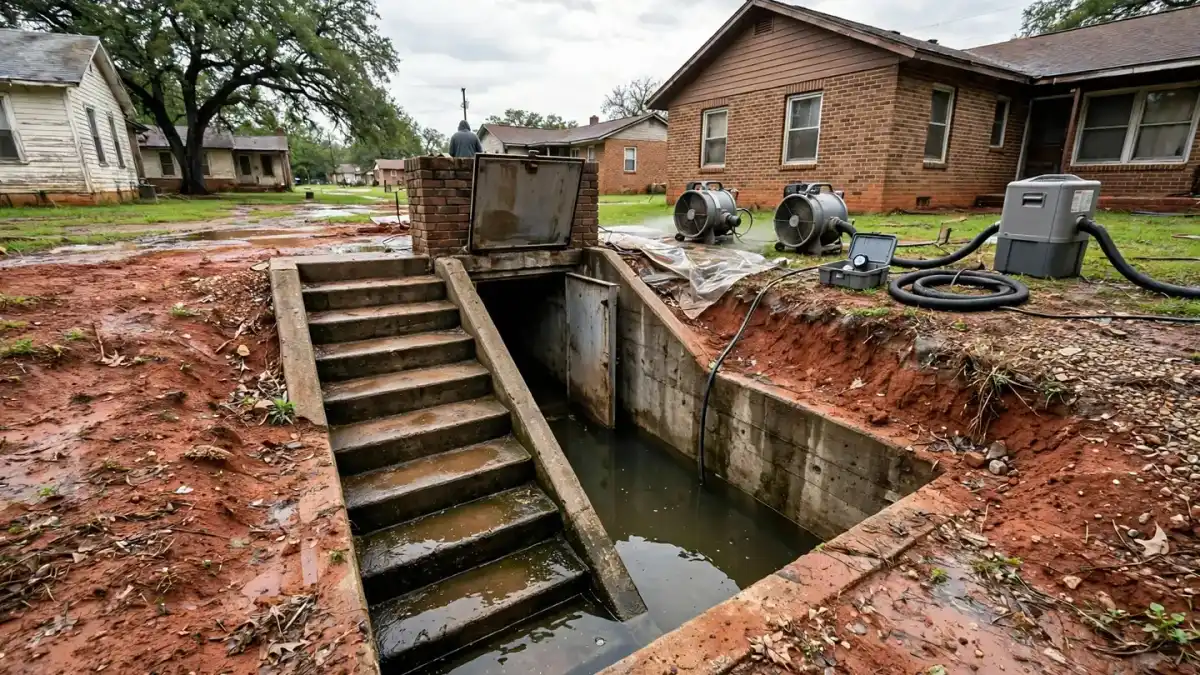
How spring storms fill south side cellars
Severe thunderstorms in central Oklahoma can drop several inches of rain in a short time. The National Weather Service office in Norman issues flash flood warnings for the metro when that happens [3]. Streets near the river and its creeks can carry water over curbs and across yards, and cellar doors, window wells and vents let it in.
Because the water comes from outside, it brings soil, lawn chemicals, oil from streets and sometimes sewage from overloaded lines. EPA's flood cleanup advice treats that water as contaminated and stresses protecting yourself during cleanup [1].
Starting cleanup in a Capitol Hill cellar
Work in this order once the storm has passed.
- 1
Stay out until power is safe
Do not step into standing water near outlets, panels or a gas water heater.
- 2
Record the water line
Photograph the depth on the walls and every damaged item.
- 3
Pump or extract the water
Remove standing water steadily, not all at once if walls are old masonry.
- 4
Clear out soaked contents
Move wet stored items outside to be sorted or thrown away.
Masonry and dirt floors in older cellars
Older Capitol Hill cellars often have brick or rough concrete walls and, sometimes, a dirt or thin concrete floor. Masonry takes in water and gives it back slowly, so a cellar can feel damp for weeks after it is pumped out. Dirt floors turn to mud and keep feeding moisture into the air above.
Drying a space like this means steady dehumidification over time, not a day of fans. A crew may also scrape out silt, treat surfaces after cleaning and lay a vapor barrier over an earthen floor once it dries enough.
What has to go after floodwater
EPA advises throwing away porous items soaked by floodwater when they cannot be cleaned and dried well [1]. In a cellar, that often means cardboard boxes, stored clothing, old rugs, mattresses and paper records. Hard plastic, metal and glass can usually be washed and disinfected.
Make a list and take photos before anything leaves the property. Insurers and adjusters want to see what was lost, and it is hard to recall details after the fact.
Flood coverage questions near the river
If storm water came across the ground and into your cellar, it is generally treated as flood. Flood coverage comes from the National Flood Insurance Program or private insurers, and standard homeowners policies usually exclude it [2]. The FloodSmart site explains how to look up flood zone maps for an address.
If water came from a backed-up drain or a broken pipe instead, the answer may differ. The Oklahoma Insurance Department has consumer help on claims and can answer questions about your policy [5].
Things to tell the contractor about your cellar
These shape the plan before anyone arrives.
- How deep the water isInches on the floor or above the outlets.
- Where it came inCellar door, window well, wall crack or floor drain.
- What equipment is down thereWater heater, furnace, panel or washer.
- What the walls and floor areBrick, block, poured concrete or dirt.
Equipment in a flooded Capitol Hill utility pit
Water heaters, furnaces and electrical panels are often in the lowest part of an older house. Once they have been under water, they should be checked by a qualified technician before use. Gas controls and electrical parts can fail in unsafe ways after a soaking.
Ready.gov's flood safety advice covers staying out of water that may be energized and waiting for the all-clear before returning to a flooded area [6]. A plumber or electrician can confirm what can be restarted.
Storefront lower levels on Commerce Street
Business owners in the historic commercial district may share walls and drainage with the building next door. Water in one lower room can reach the next, so it helps to talk with neighbors and the building owner early. A lease usually spells out who handles the structure and who handles the contents.
Keep a record of the days the business could not open. Some commercial policies include business income coverage for a closure caused by a covered loss.
Stopping mold in a damp cellar
EPA advises drying wet materials within 24 to 48 hours where possible to keep mold from taking hold [4]. A cellar that stays humid after a flood can grow mold on wood stairs, shelves and stored items. Dehumidifiers and good airflow are the main tools, along with removing anything that stays wet.
Our guide on mold risk after water damage explains signs to watch. For other south side risks, see the Capitol Hill area page.
Reducing runoff into a Capitol Hill cellar
Simple grading and gutter fixes go a long way. Make sure downspouts carry water several feet away from the house, keep window wells clear, and check that cellar doors close tightly. Soil that slopes toward the foundation sends rain straight to the lowest opening.
For homes near the river or a creek, ask whether the property sits in a mapped flood zone. Flood policies often have a waiting period, so it is best to sort it out before storm season [2].
FAQ
Flooded Cellars in Capitol Hill: questions
Is cellar floodwater in Capitol Hill safe to touch?
Treat it as contaminated. Wear boots and gloves, keep children and pets away, and wash your hands well after any contact.
Does homeowners insurance pay for storm water in my cellar?
Usually not when water rose from the ground. That is flood, which needs separate flood coverage. A backed-up drain or broken pipe may be treated differently.
How long will a brick cellar take to dry?
Often several weeks. Masonry releases water slowly, so steady dehumidification and moisture readings guide the timeline.
Sources and citations
- [1]U.S. EPA: Flood cleanup to protect indoor air quality
- [2]FEMA FloodSmart: National Flood Insurance Program
- [3]National Weather Service, Norman forecast office
- [4]U.S. EPA: A brief guide to mold, moisture and your home
- [5]Oklahoma Insurance Department
- [6]Ready.gov: Floods
- [7]Metropolitan Library System: Capitol Hill history