

Key facts: Sewage Backup in the Paseo
- Under IICRC guidance, sewage is grossly contaminated water and porous materials it reaches are removed [1].
- In Oklahoma City, the owner generally answers for the private sewer line between the house and the public main [4].
- Many Paseo buildings, with their stucco walls and clay tile roofs, date from the district's 1929 founding era [7].
Old drain lines under Paseo cottages
Many Paseo houses still have drain lines installed when they were built. Cast iron corrodes from the inside, and clay pipe has joints every few feet that roots can enter. The district's mature trees send roots toward any small crack, and the clay soil moves with wet and dry seasons [9].
Because the main drain runs through the crawlspace and out to the street, a break can leak sewage under the house long before anything comes up inside. A sewer smell in the house or a damp patch under the floor is worth a plumber's camera inspection.
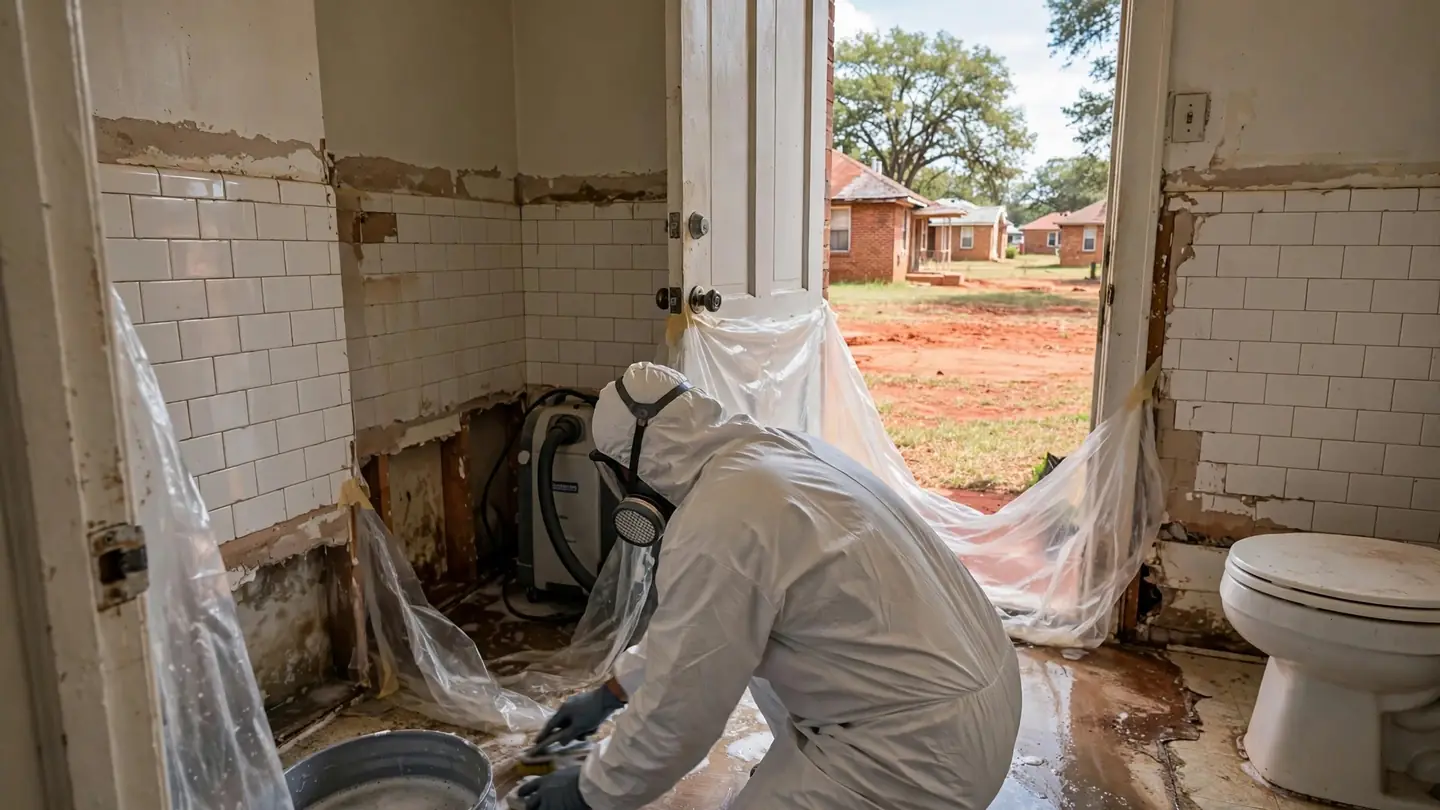
When sewage comes up inside a Paseo house
When the main line blocks, wastewater rises out of the lowest fixture, often a tub or shower in an original bathroom. It can spill across vintage tile and onto wood floors. Stop using water immediately and keep everyone, especially children and pets, away from the area [2].
Original tile set in a mortar bed is often durable and can be cleaned and disinfected. Wood floors that absorbed sewage usually need the affected boards replaced. Our Paseo page describes these vintage bathrooms in more detail.
Cleaning a sewage backup in a Paseo bungalow
The usual sequence once the line is cleared.
- 1
Stop all water use and close off the room
This limits how far the sewage spreads.
- 2
Have a plumber clear the main and run a camera
The footage shows whether the line is broken.
- 3
Remove soaked flooring, rugs and lower plaster
Porous materials are discarded per IICRC guidance [1].
- 4
Clean, disinfect and dry the room and crawlspace
Surfaces are sanitized before drying starts.
Sewage in the crawlspace
A cracked drain under the floor can leak sewage onto the soil and vapor barrier. The smell rises through the floor, and the area becomes unhealthy to work in. Cleanup means removing contaminated insulation and barrier, treating the soil surface and disinfecting the joists and piers.
After cleaning, the crawlspace is dried and a new vapor barrier is laid. Workers wear protective gear in these spaces. EPA's flood cleanup guidance explains why contaminated water calls for gloves, boots and ventilation [5].
Warning signs of a failing Paseo sewer line
Catch these before a full backup.
- Slow drains throughout the houseOne slow sink is local; many point to the main.
- A sewer smell near the floor registersIt may be coming from the crawlspace.
- Gurgling when the washer drainsAir is trapped by a partial blockage.
- Wet soil near the cleanout or along the drain pathA cracked line may be leaking outside.
City main or private line near the Paseo
If several neighbors have backups at the same time or sewage comes up in the street, the problem may be in the public main. Contact Oklahoma City's utilities department [4]. Problems on your side of the connection are yours to repair.
A plumber can tell you which it is. Replacing or lining an old private sewer line is permitted plumbing work [6]. If the work disturbs the front yard or the exterior of the building, check whether the historic district has any requirements [8].
Insurance after a Paseo backup
Many homeowners policies exclude sewer and drain backups unless a water backup endorsement was added [3]. Check your policy before cleanup begins, and take photos of the fixture, the floors and anything thrown out.
Our mold risk guide explains what to watch for in the weeks after a backup. The structural drying page covers how floors and walls are dried after cleaning.
Living and working around a Paseo sewage cleanup
A sewage job in a small cottage often takes over the bathroom, the hall and the crawlspace at once. Most families find it easier to stay with relatives for a few nights while contaminated materials come out and disinfection is under way. Keep receipts for any lodging, since some policies help with displacement after a covered loss.
Studio and gallery owners may need to close for a few days. Tell visitors the space is shut for repairs, keep the door locked while crews work, and ask the contractor for a written timeline you can share with the building owner and your insurer.
FAQ
Sewage Backup in the Paseo: questions
Can vintage bathroom tile be kept after a backup?
Often yes. Glazed tile in a mortar bed can be cleaned and disinfected, though grout may need attention.
Why does my Paseo house smell like sewer but nothing backed up?
A cracked drain under the floor may be leaking into the crawlspace. A plumber's camera can find it.
Who handles a backup in a shared commercial building?
The building owner usually handles the plumbing. Each tenant documents their own losses for their insurer.
Sources and citations
- [1]IICRC: Standards (ANSI/IICRC S500 water damage restoration)
- [2]Ready.gov: Floods (safety during cleanup)
- [3]Oklahoma Insurance Department
- [4]City of Oklahoma City: Utilities
- [5]U.S. EPA: Flood cleanup to protect indoor air quality
- [6]U.S. EPA: A brief guide to mold, moisture and your home
- [7]Wikipedia: Paseo Arts District
- [8]A Better Life OKC: Historic neighborhoods and preservation districts
- [9]Wikipedia: Expansive clay